Hemp seed oil or CBD oil: what is the difference?
One is a kitchen oil pressed from seeds, the other an extract measured in milligrams. How to tell them apart.
One name, two products
In Belgium, “hemp oil” — hennepolie in Dutch, huile de chanvre in French — usually means oil cold-pressed from the seeds: the one on the cold-pressed oils shelf in a supermarket, an organic shop or a drugstore. Belgium's FPS Public Health puts it the same way: hemp seed oil is pressed from the seed and contains no CBD. CBD oil comes from another part of the plant and is sold in small bottles with a dropper; people also call it “cannabis oil”.
Both come from industrial hemp, and on some labels their names are almost identical. The table shows where they part ways.
| What you compare | Hemp seed oil | CBD oil |
|---|---|---|
| Part of the plant | Seeds | Flowers and leaves |
| How it is made | Cold pressing | Extraction with CO₂ or ethanol, then diluted in oil |
| CBD | No (at most traces) | The main ingredient, measured |
| How it is measured | In millilitres | In milligrams of CBD and percent |
| Usual pack | Bottles of 100–500 ml | 10–30 ml bottles with a dropper |
| On the INCI list (cosmetics) | Cannabis Sativa Seed Oil | Cannabidiol |
| Status in the EU and Belgium | Ordinary food, within the THC limits | As food it is novel food without authorisation; offered as a cosmetic |
Seed oil: a kitchen oil
Hemp seeds are pressed just like flax or sunflower seeds. Cannabinoids form in the glands on the flowers, not in the seed, so CBD shows up in the oil at most as a trace, from contact with the rest of the plant at harvest.
It is an ordinary food with a history of consumption in the EU, so it is not novel food. In Belgium foods containing parts of the cannabis plant are banned in principle, but hemp seed, hemp seed oil and their derivatives are the exception, as long as they respect the THC limits: 3 mg/kg for the seed and 7.5 mg/kg for the oil (FPS Public Health; Regulation (EU) 2023/915). It is used cold — in salads or drizzled over food — because it handles high heat poorly and is not suited to frying. In cosmetics it appears on the INCI list as Cannabis Sativa Seed Oil, which is why you also find it in skin and hair products.
CBD oil: an extract measured in milligrams
CBD oil is an extract from the flowers and leaves of industrial hemp, diluted in a base oil — often hemp seed oil itself, MCT oil from coconut or olive oil. So seed oil may well be in the CBD bottle, but as the base, not as the source of CBD.
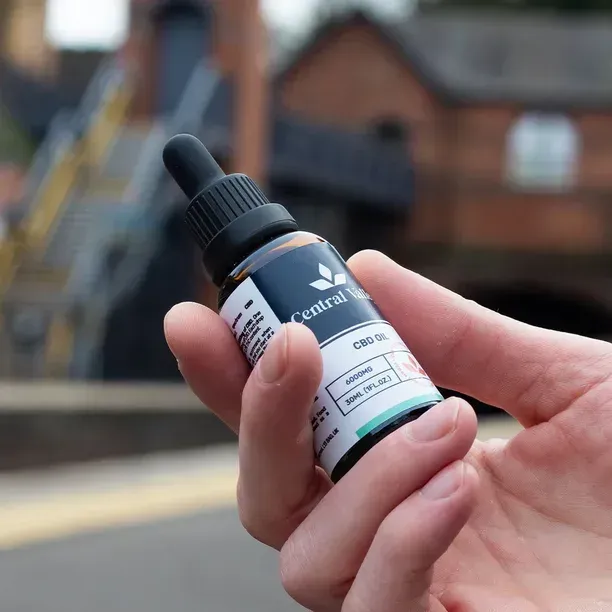
The amount of CBD is given in milligrams per bottle or as a percentage, and both say the same thing: 10 % in a 10 ml bottle means 1000 mg. The type of extract — full spectrum, broad spectrum or isolate — is explained in the article on spectrums.
As a food, CBD oil is not allowed, and Belgium's FPS Public Health regards a CBD product intended to be ingested as illegal, whatever its label says. So an oil with CBD is offered as a cosmetic product, with directions for use on the label; use it only as it says there. In the catalogue you find the amount of CBD on each oil's page.
How to tell them apart on the label
The name on the front is marketing; the ingredients on the back are the maker's declaration. Check in the order below; the step-by-step guide shows how to read the lab report.
- Look for “CBD” or “cannabidiol” in the ingredients list, not just in the product name.
- Look for a figure: milligrams of CBD or a percentage. Seed oil is measured only in millilitres.
- Look at the volume: a 250 ml bottle at a cooking-oil price is seed oil.
- Look for the batch lab report. For CBD oil it is normal to have one; for food seed oil it makes little sense.
- In cosmetics read the INCI list: Cannabis Sativa Seed Oil is the seed oil, Cannabidiol is the CBD.
- With capsules, the figure must be milligrams of CBD per capsule. If it only says how many milligrams of oil the capsule holds, it is seed oil.
If the label says CBD but the shop has no batch report, that is a problem. A food seed oil without a report is normal.
How to compare the price
The two oils are not compared with each other on price: with seed oil you pay for volume, with CBD oil you pay for the milligrams of CBD. A big bottle of cooking oil is not a cheaper kind of CBD oil.
Between two CBD oils, divide the bottle's price by the milligrams of CBD in it. The result, the price per milligram, is the only figure that compares them fairly: a 20 % bottle may cost more than a 10 % one and still be cheaper per milligram.
What the law says about each
Hemp seed oil is sold freely, like any cooking oil, as long as it stays below the THC limit. CBD extracted from the plant falls under a different regime: in the EU it is novel food (Regulation (EU) 2015/2283) without authorisation. Belgium's FPS Public Health, on a page updated on 1 September 2026, writes that CBD may not be placed on the market in any form as a food or food supplement. In February 2026 EFSA set a provisional safe level of about 2 mg of CBD a day for an adult, only for highly purified CBD in supplements; for people under 25, pregnant or breastfeeding women and those taking medicines, safety could not be established. It is a conclusion of a scientific assessment, not a recommendation to use.
That is why an oil with CBD is offered as a cosmetic product under Regulation (EC) No 1223/2009, notified in the EU CPNP portal. The hemp both oils come from falls under Belgian drug rules only above 0.3 % THC (royal decree of 6 September 2017).
The Court of Justice of the EU ruled in 2020 that CBD is not a narcotic drug (Kanavape case, C-663/18). It is not a medicine either, though, and does not replace a doctor's advice.
Matching products
Sources
- FOD Volksgezondheid — FAQ Cannabis voor consumenten (version May 2026)
- FOD Volksgezondheid — CBD als levensmiddel verboden in Europa (last updated 1 September 2026)
- Regulation (EU) 2015/2283 on novel foods
- EFSA: Provisional safe level for cannabidiol as a novel food (9 February 2026)
- Regulation (EC) No 1223/2009 on cosmetic products
- Commission Regulation (EU) 2023/915 on maximum levels for certain contaminants in food (Δ9-THC in hemp seeds and seed oil)
- Koninklijk besluit van 6 september 2017 houdende regeling van verdovende middelen, psychotrope stoffen en precursoren (Justel)
- Court of Justice of the EU, case C-663/18 Kanavape, judgment of 19 November 2020