How to choose your first CBD oil: six checks before you buy
The label and the batch report tell you more than any advert or forum thread. Here is what to look for.
First: what kind of product is it?
A cosmetic product follows Regulation (EC) No 1223/2009, is notified in the EU CPNP portal before it goes on sale and has its directions for use written on the label. CBD added to food and food supplements is novel food without EU authorisation, and Belgium's FPS Public Health calls CBD products intended to be ingested illegal, even when that use is not stated on the pack.
So the first question is not “how strong is it” but “what does the pack say”. The label tells you what kind of product you are holding and how it is used.
The way to use the product and the amount are those on its label; we give no other directions. If you are pregnant, breastfeeding or taking medicines, ask your doctor or pharmacist first.
Full spectrum, broad spectrum or isolate?
The type of extract tells you what else is in the bottle besides CBD. The choice comes down mostly to one thing: whether you accept traces of THC.
For a finished oil we found no separate numerical THC limit in Belgian sources, and cannabis above 0.3 % THC falls under the drug law. If you want to avoid any trace — say, because you are drug-tested at work — choose broad spectrum or isolate and check that the report shows THC as “not detected”.
- Full spectrum: CBD together with the other hemp compounds — minor cannabinoids, terpenes — and possible traces of THC. It has a strong plant smell and taste.
- Broad spectrum: the same plant compounds, but with the THC removed.
- Isolate: purified CBD, without the other plant compounds. Almost odourless.
Milligrams say more than the percentage
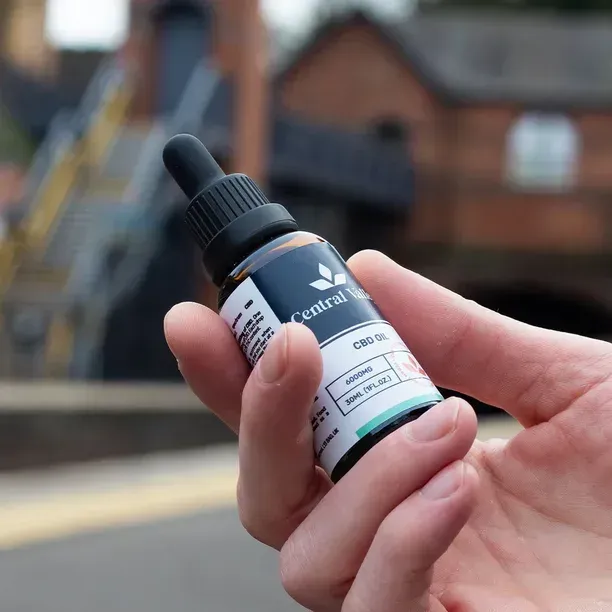
The percentage shows concentration, not quantity. A 10 ml bottle at 10 % and a 30 ml bottle at 10 % have the same concentration, but the second holds three times as much CBD. Look on the label for the milligrams in the whole bottle and the volume: without them you have nothing to compare.
For a first oil, a small bottle lets you find out whether the smell, the dropper and the base oil suit you before you buy a large one. How to turn percentages into milligrams and how to compare an oil with a box of capsules is in our guide to mg and percentages.
The lab report for your batch
Quality does not show in the percentage, nor in the price, nor in experiences on a forum — those describe someone else's bottle. It shows in the report of an independent lab, made on the batch your bottle comes from. A serious seller publishes it on the product page; how to read it step by step is on our Lab reports page.
- The batch number in the report is the same as on the bottle.
- The measured CBD matches the label, within a small margin, usually ±10 %.
- THC is “not detected” or present only in traces.
- There are results for heavy metals, pesticides and residual solvents.
- The lab's name, the method and the date of the analysis are shown.
The oil the CBD is dissolved in
CBD is dissolved in a base oil, which gives it its colour, its smell and the way it flows. On a cosmetic you find it in the ingredients list under its INCI name — the standard name used across the EU, which you can look up in the EU CosIng database.
Watch out for a common mix-up: “Cannabis Sativa Seed Oil” is hemp seed oil, which contains practically no CBD. CBD appears in the list as “Cannabidiol” or as a hemp extract, and its amount is shown by the milligrams on the label and by the lab report.
If the oil is flavoured, for example with lavender or mint, the essential oils are listed too, and fragrance allergens such as linalool or limonene are named separately.
| Base oil | In the ingredients (INCI) | What you notice |
|---|---|---|
| MCT oil (from coconut) | Caprylic/Capric Triglyceride | Thin, almost odourless, keeps well. |
| Hemp seed oil | Cannabis Sativa Seed Oil | Greenish, with a nutty, grassy smell; oxidises faster, so keep it cool and dark. |
| Olive oil | Olea Europaea Fruit Oil | Familiar smell, thicker. |
Who sells it and who is responsible for it
A web shop must show on its site its name, geographic address and contact details, including an e-mail address, and its company number (Code of Economic Law, Art. XII.6). If you cannot find them, you have no one to turn to when something goes wrong. Ours are on the About us page.
On the pack of a cosmetic you should also find the name and address of the responsible person in the EU, the batch number, the nominal content and either the expiry date or the open-jar symbol showing how many months the product can be used after opening (Regulation (EC) No 1223/2009, Art. 19). A sealed bottle can be returned within the legal 14-day period, an opened one cannot — the details are on the Returns page.
Matching products
Sources
- Regulation (EC) No 1223/2009 on cosmetic products
- Regulation (EU) 2015/2283 on novel foods
- FOD Volksgezondheid — CBD als levensmiddel verboden in Europa (last updated 1 September 2026)
- Wetboek van economisch recht, art. VI.47, VI.53 en XII.6 (Justel)
- CosIng — European Commission database of cosmetic ingredients