What is CBD (cannabidiol)?
Where it comes from, how it differs from THC, how to recognise it on the shelf and what it does not promise.
A compound from hemp
CBD is short for cannabidiol, one of the more than one hundred cannabinoids the hemp plant (Cannabis sativa L.) produces. It sits mostly in the flowers and leaves; the seeds hold almost none.
The CBD in products sold in the EU comes from industrial hemp: varieties from the EU common catalogue, grown for fibre and seed. EU farm rules admit varieties with at most 0.3 % THC, and since 1 June 2024 Belgian drug rules use the same line. Industrial hemp and marijuana are one species but different varieties — the difference lies in the amount of THC.
Is CBD the same as THC?
No. THC (tetrahydrocannabinol) is the compound that causes the “high”. CBD does not, and that is the difference that matters: it is why CBD products can be sold while THC falls under the drug law. The full comparison is in CBD vs THC: what is the difference.
In 2018 the World Health Organization's Expert Committee on Drug Dependence reviewed cannabidiol and concluded that, in its pure form, it shows no potential for abuse or dependence and should not be placed under international control. In 2020 the Court of Justice of the EU ruled that CBD is not a narcotic drug.
What CBD is not
CBD is not a medicine. There is no authorised health claim for CBD in the EU (Regulation (EC) No 1924/2006), and a cosmetic may claim only what is cosmetic and backed by evidence. A serious seller describes the product's composition and form, not effects on health.
CBD products are for adults only. Assessing CBD as a novel food, EFSA, the European Food Safety Authority, wrote in February 2026 that its safety cannot be established for people under 25, for pregnant or breastfeeding women and for people taking medicines. Belgium's FPS Public Health strongly advises against use during pregnancy and breastfeeding. If any of this applies to you, ask your doctor or pharmacist first.
If a shop presents CBD as a medicine, it is breaking EU rules — a good reason to shop elsewhere.
The law in brief
Belgian drug rules (royal decree of 6 September 2017) limit THC, not CBD: since 1 June 2024 cannabis counts as a controlled substance only above 0.3 % THC. CBD cosmetics are allowed under the conditions of Regulation (EC) No 1223/2009.
CBD added to food and food supplements is novel food (Regulation (EU) 2015/2283) with no EU authorisation, and the FPS Public Health states that it may not be sold as a food in any form. The details are in Is CBD legal in Belgium?
What it looks like on the shelf
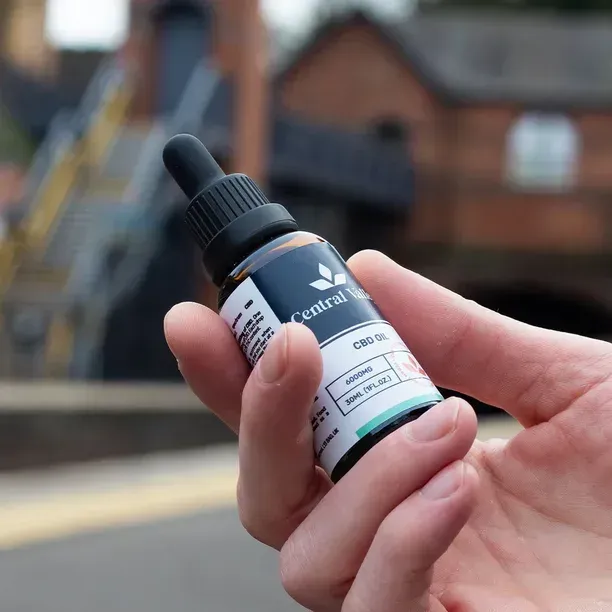
CBD is sold in a few forms, and each label states the category: cosmetic, food or another. The category, not the shape of the bottle, tells you how the product may be used.
| Form | What it is | What to check |
|---|---|---|
| CBD oil (CBD drops) | Hemp extract dissolved in a vegetable oil, in a dropper bottle | The milligrams in the whole bottle and the category on the label |
| Creams, balms, serums | CBD in a cosmetic base, for the skin | That it is labelled as a cosmetic, and the ingredient list |
| Capsules | Extract measured into identical capsules | The category on the label: as a food supplement, CBD is not allowed |
| Hemp seed oil | Food oil pressed from the seeds | Practically no CBD: it is not CBD oil |
What to read on the label
The percentage alone can mislead you: a 10 ml bottle at 10 % holds 1000 mg of CBD, while a 30 ml bottle at 5 % holds 1500 mg. Compare products by the milligrams in the whole pack and by what the lab report shows.
- The amount of CBD in milligrams for the whole pack, not just the percentage.
- The bottle volume or the number of capsules.
- The extract type: full spectrum, broad spectrum or isolate.
- The batch number — the same as on the lab report.
- THC on the report: “not detected” or only traces.
- The product category and the directions written on the label.
Matching products
Sources
- WHO Expert Committee on Drug Dependence: fortieth report (2018)
- Court of Justice of the EU, case C-663/18 Kanavape, judgment of 19 November 2020
- Koninklijk besluit van 6 september 2017 houdende regeling van verdovende middelen, psychotrope stoffen en precursoren (Justel)
- FOD Volksgezondheid — FAQ Cannabis voor consumenten (version May 2026)
- Regulation (EC) No 1924/2006 on nutrition and health claims made on foods
- Regulation (EC) No 1223/2009 on cosmetic products
- Regulation (EU) 2015/2283 on novel foods
- EFSA: Provisional safe level for cannabidiol as a novel food (9 February 2026)